HAVING THEIR CAKE:
SUSTAINABLE SOCIETIES, CLIMATE CHANGE AND THE QUALITY OF LIFE ON OUR PLANET
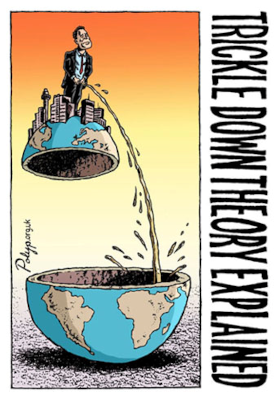
Civil Societies across the world are under great stress. The root causes are the power of financial and political elites, which have had the freedom to act as they will and increase their wealth without regard to the interests of the majority of population. Work has been degraded, people treated like objects and they have seen their wellbeing and earnings steadily reduced. It has sunk into the popular awareness that the promises and uplifting messages with they are fed are based on a tissue of untruths, and many people are becoming very angry with the causes of their misery – “Them”, the elites who control societies. Recent happenings are a result of popular rage at inequality and powerlessness. How this will play out is impossible to predict, for rich elites do not yield their privileges easily. But Climate Change is entering the wider consciousness, and pressure, led by young people, may start to shift the balance of power.
History of this site: From healthy corporations to sustainable societies - A journey of discovery
“Having Their Cake” had its genesis in a book of that name, published in 2004, and written with corporate treasurer Pat Scott as a result of our experiences as directors of large international companies. It examined the relationships between large corporations and the investment markets - and the effects on the behaviour of top managers - which in turn affected the performance of these companies and the wider economy.
But as the site developed, it was driven by my increasing concerns about the quality of living in many communities, in both rich and developed and poorer nations.
To explain: the roots of the concerns explored in this site lie in my own background.
I was educated in a school that took people from all social classes and I learned to appreciate people for who they were, not for their wealth or social backgrounds. Higher education was at the London School of Economics on a local government grant. LSE was an institution that had a reputation for left wing politics, but this was totally wrong - we were simply encouraged to think for ourselves and avoid mindlessly accepting conventional “wisdom”.
First experiences as a manager
After university, I was selected for a management traineeship by Unilever, a very international company of Anglo- Dutch ownership, which had a tradition of treating its customers ethically and staff with dignity in the belief that these values would also make it financially successful.
In my later career, I became a director of large international companies whose shares were quoted on the London Stock Market. I worked all over the world; spent a lot of time in the United States, and was also a director of Japanese and German companies, so had experience of different business cultures.
Concerns about influence of financial markets
In time, I came to understand that companies and markets were not part of a closed system, and began to think about the wider economy. As my exploration continued, it became clear that it was not possible to separate economies from the societies of which they were a part.
The Planet in Peril, the biggest Issue of All
History, culture, political/economic philosophies and dogma, finance and politics - all influence the quality of societies, and in turn the quality of human existence. The vast and growing differences between rich and poor countries and the conflicts generated by gross inequality are endangering the future of the planet and the lives of all species, not just humans. Now, the peril.
So this site has morphed into an examination of Societies in their myriads of different forms.
Whilst this website is based on the best factual information that I can find, it is inevitably underpinned by my own experiences and values. The central one is that Societies should serve the interests of all their members, not just a rich and powerful minority. There is good evidence that societies based on marked inequality are not sustainable. Sooner or later they will suffer from stress or breakdown and cease to function effectively.
So browse this site if you are interested in the ideas that affect our financial, political and social lives - but most important, the future of Planet Earth and all the species in it.